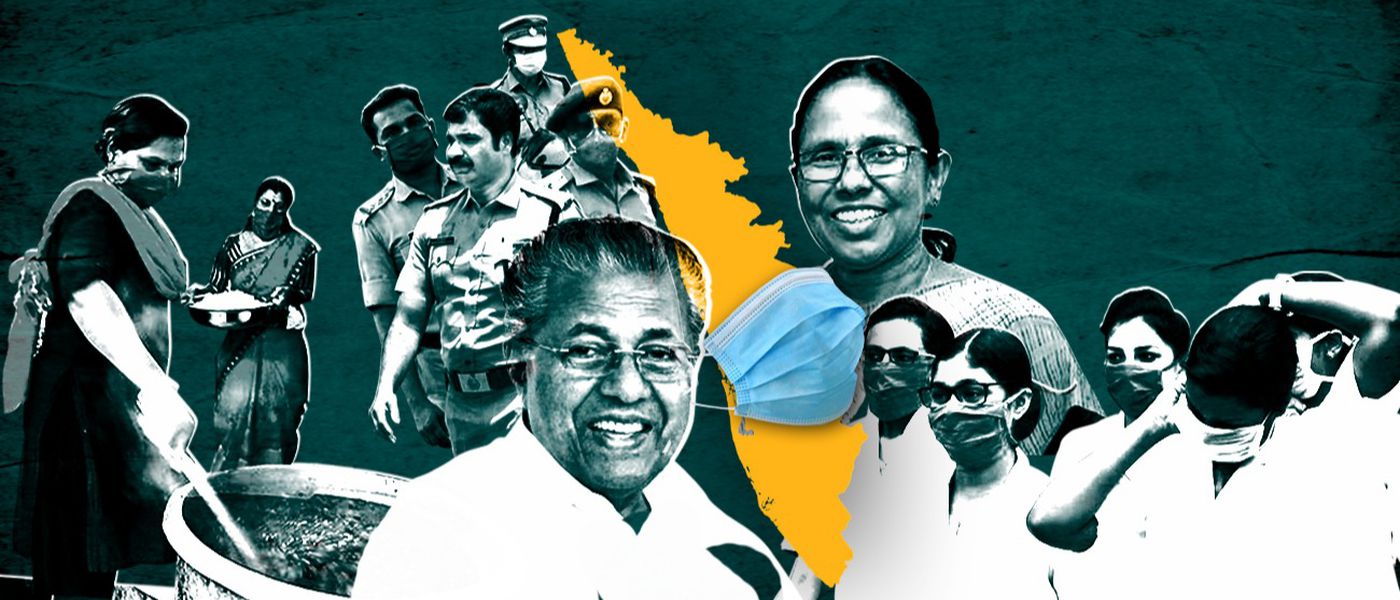
Kerala takes on Covid
Covid was first confirmed in Kerala on January 30, when a student who had come from Wuhan was admitted to hospital with the infection. One case each was confirmed in Alappuzha on February 2 and in Kasaragod on February 3. At that time no other state in India had reported Covid-19. There were fears that the disease would spread in Kerala as it did in other parts of the world. But when two patients left hospital on February 16 and the remaining one on February 20, Kerala was free of the disease. After a gap of a few days, the disease was reported in Kerala a second time on March 8, when five people were confirmed positive in Pathanamthitta district: three who had come from Italy and two of their relatives.
"What Kerala thinks today, India will think tomorrow," the well-known journalist Rajdeep Sardesai wrote on Twitter, referring to how Kerala was treating Covid-19. A BBC presenter's question to virology expert Shahid Jameel about what could be learnt from the Kerala model was also widely discussed on social media. He replied that it was because of the excellence of Kerala's health care system that it had been able to contain Covid-19 in the first phase. It is primary health centres, not hospitals, that first come into contact with patients, and they are able to diagnose the disease and carry out tests effectively, he added.
The first steps the government took
Thermal screening of passengers arriving from China began in India on January 23. On central instructions, controls were introduced at Kochi airport in Kerala too. Those who had come to Kerala from China or other countries where corona infection had been confirmed were told they must stay at home for 28 days and go out only for medical help. The DISHA toll-free number (1056/04712552056) was set up for this. The DISHA toll-free number was started in 2013 for counselling, guidance and other physical and mental health problems. Since January 22 it has been working round the clock as the DISHA Covid helpline.
Measures to prevent Covid began on January 25. Under the leadership of Health Minister K K Shailaja and Health Principal Secretary Dr Rajan N Khobragade, the WHO protocol was implemented. Isolation wards were set up in all medical colleges and district and general hospitals. Control rooms were opened in all districts and linked to the state central control room.
One and a quarter lakh beds were made ready in government and private hospitals. There are special corona care centres, with a three-tier system set up for this. 10,813 isolation beds were prepared, and 517 corona care centres have 17,461 isolation beds. 38 hospitals work as special corona care hospitals.
Directions given in the first phase to people arriving from abroad
Those arriving from China or other affected areas must report to the nearest primary health centre or the DISHA toll-free number.
They must not have contact with other family members at home.
They must not share plates, cups, bedsheets and the like.
They must isolate themselves at home.
Visitors at home must be avoided.
They must not attend or organise public events.
Those with symptoms such as fever, cough or sore throat must not go to hospital on their own, but inform the control room.
Lessons learnt from Nipah
In 2018 and 2019 many people in Kerala were infected with Nipah. In the first year, 17 of those infected died, a major setback for Kerala's health sector. The second time, however, no one in Kerala died of Nipah. The habits acquired in fighting Nipah helped Kerala resist Covid-19. The most important of these is contact tracing, and the first step is to find the zero patient (the first person to get the disease). Screening, first started at Kochi International Airport, was extended to other airports. In the first phase Covid-19 was confirmed in Thrissur. The patient's route map was traced and everyone who had been in contact with the patient was put under observation. This is how those likely to get the disease were found when Nipah returned in its second phase.
Route maps like this were prepared for all the patients reported in the second phase. Strict quarantine measures helped stop the disease spreading. Thousands of people were quarantined every day at home and in hospitals. After April 4 the number of people under observation also fell.
Pathanamthitta: the first district to fight off Covid
In the second phase, the disease was first confirmed in three people in Pathanamthitta district who had come from Italy. They had not informed the authorities that they had arrived from Italy, and in six days they visited 17 places. When their relatives, who came to Ranni Government Hospital with fever and other symptoms, tested positive, those who had come from Italy were traced and isolated. By then the disease had spread to eight more people. The first step was to prepare a detailed route map, marking which places they had been at and at what times. Lists of primary and secondary contacts were prepared, making use of modern technology.
Union Cabinet Secretary Rajiv Gauba said the measures Pathanamthitta took to stop the spread of Covid-19 were worth emulating. Pathanamthitta district had been declared a hotspot. Nine cases were reported in the district on March 9, and at the rate the disease was spreading, about a hundred people could have been infected. But according to the figures for April 12, only 17 people were confirmed positive, and 8 of them have recovered. Strict isolation, quarantine, screening, contact tracing and testing helped Pathanamthitta achieve this.
Pathanamthitta District Collector P B Nooh and his team delivered essential goods to homes under observation.
When the number of patients rose, the district's borders were closed. A database was prepared that included not only those who had come from abroad but also those who had come from other states and districts. Publishing the route maps of those who tested positive made it possible to find the people who had been in contact with them; many came forward on their own to say they had been at those places. Call centres were set up to stay in constant touch with those in quarantine. A student of IHRD College, Chengannur, developed an app called 'Corona RM' to record details of those under home observation, and the district authorities made use of it.
A geo-mapping system was implemented in the district, and GPS tracking was set up to track those in home quarantine. The Kerala State Disaster Management Authority's Geographic Information System (GIS) was used to mark hotspots. Estimating where the virus was likely to spread, various places in Pathanamthitta and Kottayam districts were marked on the map as high risk or low risk.
Kerala came to a standstill before the lockdown
The lockdown began across India on March 24, but strict controls came into force in Kerala before that. Even before the Janata Curfew, normal life in Kerala had more or less come to a halt. Here are the precautions taken when twelve people across the state had been confirmed positive:
Educational institutions were closed until March 31. This applied to anganwadis, madrassas, schools, colleges, professional and parallel colleges. Tuition classes, special classes and vacation classes were all to be avoided. This applied to CBSE and ICSE schools too.
Government public events were cancelled.
Cinema theatres, tourist centres and drama theatres were closed.
Learner's and driving licence tests and enforcement drives were suspended.
Festivals were limited to rituals: festivals at temples, including Sabarimala, and at churches were limited to the rituals alone.
Wedding receptions were avoided, and controls were placed on weddings and related receptions.
Strict action against hoarding of protective masks.
Instructions to avoid travel as far as possible.
Strong action against spreading fake news and baseless claims.
Fines and imprisonment for spitting in public places.
All PSC examinations were postponed.
A Rs 20,000 crore economic package
The state government announced an economic package of Rs 20,000 crore to overcome the economic crisis caused by the spread of the coronavirus.
A war room was set up to resolve problems faced inside and outside the state. It was set up under Section 2 of the Epidemic Diseases Act, 1897 and the Disaster Management Act. The war room is a small cross-section of the government. It began in the South Conference Hall of the Secretariat under the leadership of K Ilankovan IAS. Working round the clock, it is led by five IAS officers in shifts. Representatives of departments such as health, police, revenue, local self-government, transport and food and civil supplies work in the war room. It is the war room that coordinates with the governments of neighbouring states to move goods from there.
Community kitchens were started to make sure everyone gets food during the lockdown. Panchayat ward members, councillors, ASHA workers and anganwadi teachers were entrusted with finding those who need food, such as the homeless and the jobless. Food is free for the poor, and ordinary people can get lunch for Rs 20.