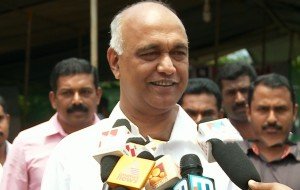
The Modi government's double standards: Elamaram Kareem
The RSS and the BMS are turning into a big propaganda weapon the Union Labour Ministry's announcement that unorganised-sector workers will be brought under the ESI scheme. The claim is that workers in sectors such as autorickshaws, construction, anganwadis and ASHA will be covered by ESI. The aim of this campaign is to confuse workers ahead of the national strike against the Centre's policies on September 2. The noise is meant to hide the anti-worker face of a government that is not willing to accept even one of the demands submitted jointly by all the country's trade unions, including the BMS.
The 43rd, 44th and 45th Indian Labour Conferences recommended that unorganised-sector workers be brought under ESI. The 46th Indian Labour Conference met last July. That tripartite conference, inaugurated by Prime Minister Narendra Modi, also recommended implementing ESI for unorganised-sector workers. Apart from the labour ministry repeating this, no step has been taken to implement the scheme.
A worker who joins ESI must pay 1.75 per cent of the monthly wage, and the employer 4.75 per cent in the worker's name, every month. The ESI scheme applies to those earning up to Rs 15,000 a month. Since unorganised-sector workers do not work under a particular employer, who will pay the employer's share? If workers have to pay both shares themselves, they cannot afford it. So the government must pay the employer's share, and money for it must be provided in the budget. How will the monthly wage of an unorganised worker be calculated? They do not have a fixed income. If the rule is that this group can join ESI by paying less than others, the law has to be amended. What is the use of an announcement without doing any of this?
The Union government is trying to destroy the existing ESI scheme. In his 2015-16 budget speech, Finance Minister Arun Jaitley announced that the ESI scheme would be made optional, and said the ESI Act would be amended for this. What the government intends instead is the medical insurance schemes of private insurance companies. This is meant to help private insurers. ESI members get not only medical benefits but also cash benefits for the days they cannot work because of illness, and a monthly pension if they are disabled or killed at work. Medical insurance gives none of these. The RSBY scheme gives nothing but treatment. A Modi government that takes this stand cannot be expected to show mercy to unorganised workers.
Ninety-three per cent of the country's workers work in the unorganised and traditional sectors, for meagre wages. They include agricultural workers who get only a few days' work a year and extremely poor traditional workers. The Dr Arjun Sengupta committee found shocking facts about their lives: 82 per cent of unorganised workers live on Rs 20 a day. That situation has not changed. During the UPA government the trade unions demanded a minimum monthly wage of Rs 10,000 for all workers; the demand now is Rs 15,000. But the government has taken no step to give workers relief.
Setting up a social security fund to provide social security benefits to unorganised workers is one of the 10 demands raised jointly by the trade unions. In 2008 the UPA government passed a social security law for unorganised workers, and a social security board was set up under it. The board submitted recommendations to the government, covering care for the elderly, health care, maternity benefits and protection for the physically disabled. But six years after the law was passed, not one of these recommendations has been implemented. Under this law the district administration must give every worker a smart card with an identity number. To this day no one has been given such a card. The government has still not set aside a social security fund. The UPA government allotted Rs 1,000 crore for it in the 2010-11 budget, but not a single paisa was spent. The situation is the same under the Modi government.
The RSBY health insurance scheme came into force in 2008. According to the government, 3.85 crore people joined it. At first it was only for those below the poverty line. It was later extended to construction workers in the unorganised sector, railway porters, street vendors, employment guarantee workers with at least 15 days of work a year, beedi workers, domestic workers, sanitation workers, mine workers, rickshaw pullers, waste pickers and autorickshaw and taxi drivers. Yet only nine per cent of the 43 crore unorganised workers have joined. That is the fate of government schemes.
What is announced is one thing; what comes into effect is another. It took seven years for this nine per cent to join. How many years will it take to enrol everyone? On May 9, 2015 the BJP government announced three new social security schemes: two insurance schemes, the Pradhan Mantri Jeevan Jyoti Bima Yojana and the Pradhan Mantri Suraksha Bima Yojana, and a pension scheme, the Atal Pension Yojana. The Atal Pension Yojana is aimed mainly at unorganised workers. All of them are contributory schemes; the government gives no financial support. The Union government, which is duty-bound to provide a social security fund for unorganised workers, has walked away from that responsibility. This is a betrayal of poor workers.
The schemes the government has now announced can only be joined through a bank account. Under the much-trumpeted Jan Dhan Yojana, 127.65 million people had opened bank accounts by February 5, 2015, and 84.34 million of those accounts have a zero balance. No balance is needed to open a Jan Dhan account. But to join the schemes the government has announced, the account must hold a minimum balance of Rs 500 in rural areas and Rs 1,000 in cities. An unorganised worker with no guarantee of steady work, who earns only two or three thousand rupees a month even when there is work, cannot keep a thousand rupees in the bank. In short, the government puts not a single paisa into any of the new schemes. It has cut funds for the employment guarantee scheme, ICDS, the rural health mission and education. The Modi government, which cuts every fund for the welfare of the poor, showers concessions on big corporates. In a short time the BJP government has outdone the UPA government in anti-people policies. Having amended every labour law in favour of employers to help the corporates who stood by it in the election, it has earned the hatred of workers. That is why workers are preparing so enthusiastically for the September 2 strike. The new ESI announcement is a deliberate attempt to create confusion and false hope among workers who have taken to the streets to challenge the government's policies.
At the same time, we must demand practical steps to implement the ESI and provident fund schemes for all unorganised workers, as the Indian Labour Conferences recommended, and the implementation of the 2008 social security law. The government policy of cutting every benefit for the poor must be exposed. Benefits can be won only through the united struggle of the working class.