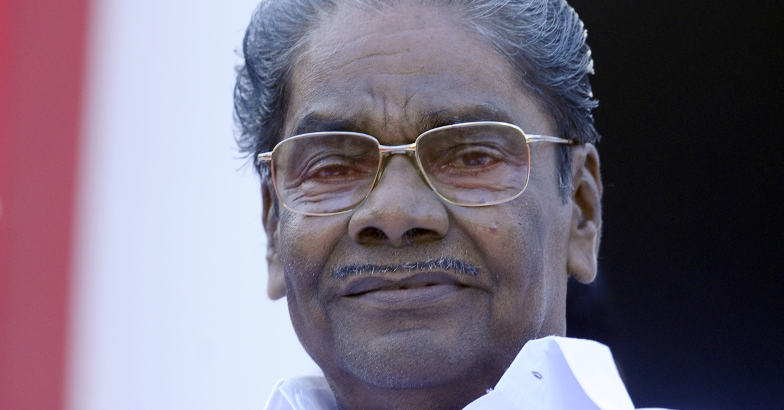
To protect the coir industry: Anathalavattam Anandan
The UDF government sees traditional industries as sunset industries, and so it does not include them in its list of industries to be protected. Lakhs of families have made a living for generations with the charkha, the spinning wheel and the loom. Society and the government have a duty to think about how they can go on living. Unfortunately, the government gives it no thought.
No one argues that traditional methods of production must continue unchanged in the modern age. More than a quarter of a century ago it was decided to adopt technology in the coir industry to raise productivity and quality, thereby increasing workers' incomes and running the industry profitably. Unfortunately, Kerala has been unable to do anything effective in this field. On the recommendation of the Coir Commission appointed by the last LDF government, it was decided to set up a factory in Alappuzha to make mechanised spinning wheels, looms and husk-beating machines; land and facilities were found and Rs 20 crore was invested. To this day the UDF government has made no attempt to run that factory or to contribute anything to the coir industry. The research centre NCRMI in Thiruvananthapuram was given the financial help it needed, and the present UDF government too has given it crores of rupees over the last three years. But it has not been able to build a single machine the coir industry could adopt. Instead of carrying out the tasks entrusted to it, it used the money every year for foreign tours. Those who hoped that NCRMI and the Coir Board's research centre at Kalavoor would contribute something to sustaining Kerala's coir industry are deeply disappointed.
As a result, Kerala, which exported coir and coir products to many countries for two centuries, has come to import coir. To produce coir you need fibre, and for that husks must be collected and fibre produced. The government takes none of the steps needed for this. As a result the coir industry is dying out in Kerala, wiping out the jobs and incomes of nearly four lakh workers. Today the husk of a coconut is worth between one and two rupees. If the husks of one third of the coconuts Kerala claims to produce (200 crore) could be collected, coconut farmers would earn at least Rs 400-450 crore more. Most importantly, four lakh workers could be given at least 240 days of work a year.
Today only 40,000 workers (10 per cent) in the coir sector have work, and even they get no more than 100 days a year. Kerala once accounted for 90 per cent of India's coir exports. But in 2013-14 Kerala's share of exports was 14 per cent; the remaining 86 per cent came from outside Kerala, 90 per cent of it from Tamil Nadu. For some years coir production in Vaikom, Cherthala, Alappuzha, Karthikappally and Kollam relied on fibre from Tamil Nadu. But Tamil Nadu exports the fibre it produces to countries such as China, and has begun spinning the rest into coir on automatic spinning machines. Instead of the fibre it used to supply to Kerala, it has started sending Kerala machine-made coir.
The coir sector faces a grave situation today, with acute unemployment in both the factory and spinning sectors. Most of the 513 coir cooperative societies, with two and three quarter lakh workers as members, lie closed, and their properties face attachment. Coirfed, which bought the products of the societies that still function nominally, has not paid on time and owes them crores of rupees. Those who work have not been paid for months. A government that gives no working capital to buy husks or pay wages has registered new societies even in hill areas without a single coir worker. The Rs 100 crore set aside in the budget for the coir industry is being spent on the newly registered societies, on foreign tours and on extravagant coir fairs. Had the money spent on the fair been used to buy fibre, pay the dues Coirfed owes the societies and run the price-support scheme, it would have brought some relief.
It was when G Sudhakaran was coir minister that a coir fair was held in Alappuzha in 2011, following the Coir Fests held at various centres. Societies were working in the factory and spinning sectors then. There were products made by workers to display, and coir products needed a market, so the fair was relevant. That is not the situation today. There is no production, and coir is being imported. Neither the Coir Corporation nor Coirfed takes over even the goods that are produced. The price-support scheme has been wrecked. Workers and small factory owners are taking their own lives. That is why people ask what good this fair does Kerala's coir industry.
In 2014 a campaign march led by Dr Thomas Isaac travelled through all the main coir areas, from Vaikom to Thiruvananthapuram, to show the people and the government the real picture of the coir industry and propose solutions. Memoranda were submitted to the Chief Minister and the minister concerned. Apart from the Chief Minister calling a meeting and saying the minister would act, not one core problem has been solved. The workers raise four main demands: protect the coir industry; guarantee work and wages; give relief money to existing workers who have no work; and raise the pension to Rs 1,000.
(The writer is general secretary of the Coir Workers Centre.)