
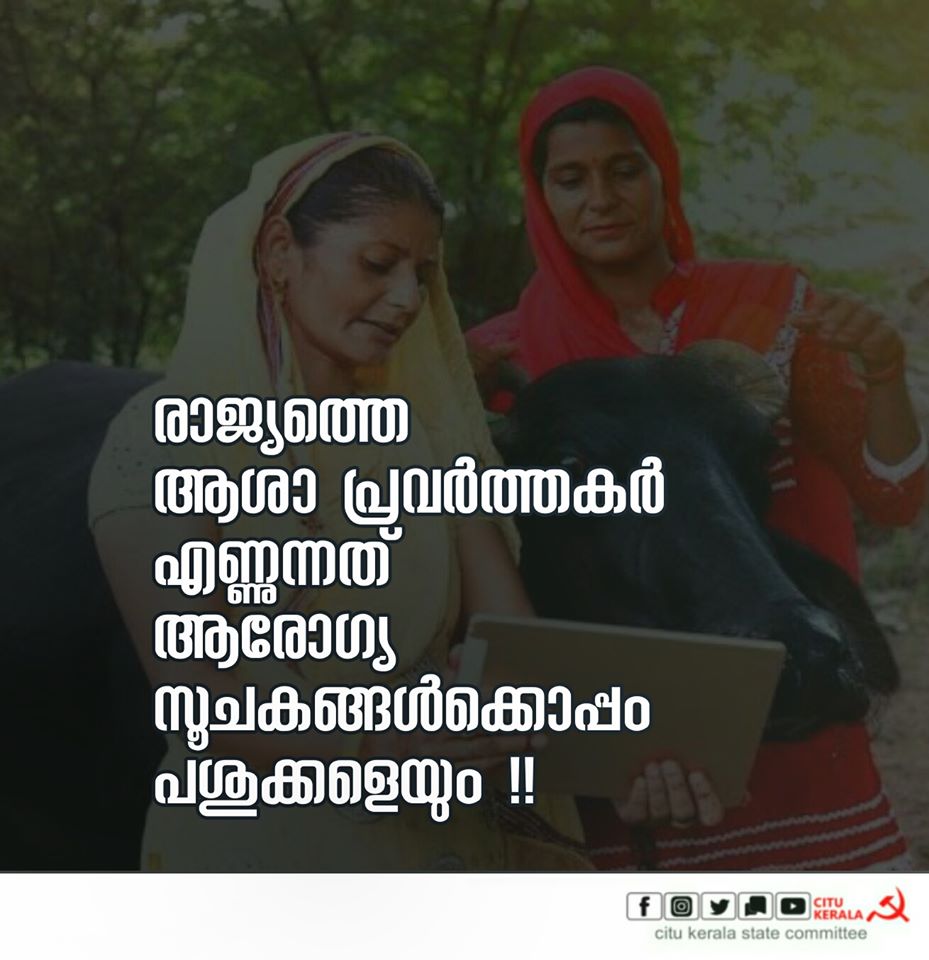
ASHA workers count not just health indicators but cows too
This note is based on an article about ASHA workers in Haryana published on PARI (People's Archive of Rural India), the website led by P Sainath.
The article was written by Anubha Bhonsle and Pallavi Prasad.
The information for the article was gathered from those taking part in a dharna by ASHA workers in Sonipat, Haryana.
The protesters' slogan was "Kaam pakka, naukri kachchi, nahi chalegi, nahi chalegi" (the work is permanent but the job is not; this won't do, this won't do).
It is ASHA (Accredited Social Health Activist) workers who link India's poor, especially rural women, with the public health system.
They are the foot soldiers of the National Rural Health Mission (NRHM).
Ten lakh ASHAs are working in the country. ASHAs have 12 primary duties or tasks and more than 60 sub-tasks.
It is the ASHAs' job to collect information on nutrition, sanitation, infectious diseases, tuberculosis and so on, and to make rural people aware of them. Collecting health information on pregnant women and children and giving them the help they need is also their job, as is checking blood pressure. On top of this, they do the work of booth-level officers for elections, count houses, count cows and buffaloes, and so on: the ASHAs' work is endless.
One ASHA worker said her work had tripled in three years.
Every day there is some new report to submit. They have no time to look after family matters or take part in a struggle. Doing so much hard work without adequate pay on time causes problems even in their families. ASHA workers raise awareness about the government's family planning schemes, the timing of pregnancy, contraception and its medicines. Thanks to ASHAs' work, the country's infant mortality rate fell from 57 per 1,000 in 2006 to 37 per 1,000 in 2017.
Hospital deliveries rose from 39% in 2006 to 79% in 2017; earlier, most deliveries took place in homes and huts. The essential medicines to be given to pregnant women are not supplied regularly, which causes them great difficulty. When they take pregnant women to hospital for treatment, they buy them water and food with their own money. ASHAs' stipends differ from state to state: only Rs 4,000 in Karnataka and Rs 1,000 in Andhra Pradesh, while travel and other daily costs come to at least Rs 100. The stipend is never paid on time.
The PARI article is titled Counting Cows Not Rural Health Indicators.
The link is given below.
https://ruralindiaonline.org/articles/counting-cows-not-rural-health-indicators/